I used to think clear kitchen counters meant almost nothing could live there. Then I would put everything away, feel very proud for about six hours, and slowly watch the coffee mug, cutting board, mail, olive oil, toaster, vitamins, and one mysterious receipt return to the counter like they had keys to the house.
That is when I stopped asking, "How do I make my counters empty?" and started asking a better question: "What actually earns a place here?"
A kitchen counter is not a showroom shelf. It is a work surface. It has to help with coffee, breakfast, chopping, school lunches, dinner, snacks, and the quiet little reset at the end of the day. So the goal is not bare counters. The goal is useful counters.
Quick answer
Keep things on the counter only if you use them every day, they make a routine easier, or they are too awkward to move constantly. Put away duplicates, occasional appliances, decorative pieces that crowd prep space, paper piles, and anything that belongs to another room.
My favorite rule is this: if something stays out, it needs either a job or a home. A coffee maker has a job. A tray of cooking oils has a home. A random stack of coupons has neither.
Start with the counter you use most
If you try to fix every counter at once, the kitchen becomes one of those projects that starts with hope and ends with everything on the dining table. I would start with the counter you touch most often.
For many people, that is the space near the coffee maker, the sink, or the stove. For others, it is the small patch of counter where lunch boxes get packed or groceries get dropped.
Stand there for a minute and notice what the space is already trying to do. Is it a breakfast zone? A chopping zone? A landing zone? A coffee zone?
Once you know the job of that counter, the decisions get easier. Anything that supports the job can stay nearby. Anything that interrupts the job should move.
What I would keep out
I like keeping a few things out when they genuinely make the kitchen easier. Not twenty things. Just the things that make daily routines smoother.
These are the counter items I think can earn their place:
- The coffee maker, if coffee happens every morning
- A toaster, if it is used most days
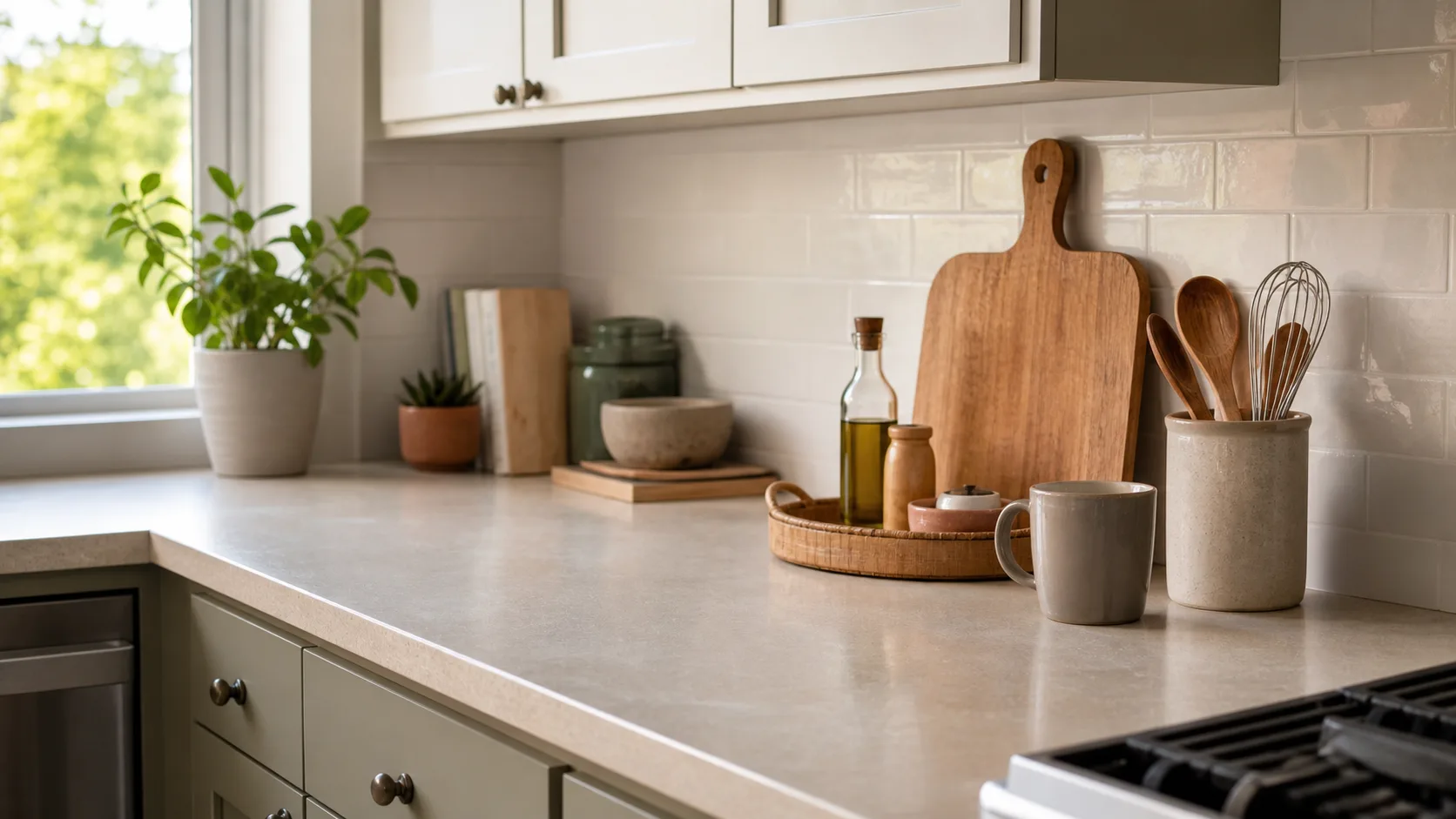
- A utensil crock near the stove
- A cutting board that gets used constantly
- A small tray for oil, salt, pepper, or cooking basics
- A fruit bowl, if people actually eat from it
- A paper towel holder, if it prevents little messes from becoming bigger ones
The important part is not the exact list. It is the reason. I would rather see one useful tray beside the stove than five pretty things that have to be moved every time someone chops an onion.
What I would put away first
The first things I would move are the objects that make you work around them. You know the ones. They are not terrible. They are just always in the way.
Start with:
- Appliances used once or twice a week
- Extra mugs
- Duplicate utensil containers
- Mail and school papers
- Vitamins and medicine bottles
- Random tools from other rooms
- Decorative items that take up prep space
- Anything sitting out because you do not know where else to put it
I am not saying these things are bad. I am saying the counter is expensive real estate. If an appliance only comes out on Saturdays, it probably does not need a weekday parking spot.
The appliance question
Small appliances are where people get stuck, because the answer depends on real life. A toaster can be clutter in one kitchen and a lifesaver in another.
Here is how I would decide:
If you use it every day, keep it out if you have the room. If you use it a few times a week, try giving it an easy cabinet or pantry spot. If you use it once a month, it does not belong on the counter.
The trick is making the put-away spot realistic. If the blender is heavy and the only empty shelf is above your head, you will not put it away. You will leave it on the counter and resent it. In that case, look for a lower cabinet, a rolling shelf, or a spot near where you use it.
Useful is better than hidden. But hidden is better than constantly in the way.
Use trays carefully
A tray can make a counter look intentional very quickly. I love that. But a tray can also become a tiny clutter island if everything gets permission to land there.
The tray beside the stove works because it has a clear job. It can hold olive oil, salt, pepper, maybe a small spoon rest. That is it.
A tray near the coffee maker might hold coffee pods, sugar, tea bags, or spoons. Again, useful and contained.
What I would avoid is the "miscellaneous tray." That usually becomes a place for keys, receipts, hair ties, tape, batteries, and the pen that never works. If your tray cannot be named, it is probably not solving anything yet.
Keep one landing spot, but make it small
Most kitchens need a landing spot. Groceries arrive. Mail appears. Someone empties a pocket. A recipe gets printed. Pretending this will never happen is how clutter ends up spreading across every surface.
I would choose one small landing spot and keep it almost annoyingly limited. A shallow basket, a letter tray, or one corner of the counter can work.
The rule is simple: temporary only.
This spot can hold:
- Today's mail
- A grocery list
- A recipe for this week
- One item that needs to leave the house
- A note you need to see tomorrow
It should not hold three weeks of paper, broken sunglasses, chargers, receipts, and things that belong upstairs. If it starts doing that, it needs a five-minute reset, not a bigger basket.
Make the stove area easy to cook in
The space around the stove is one of the few places where keeping things out can make a lot of sense. When you are cooking, you do not want to dig for salt every time.
I would keep the basics close:
- Cooking oil
- Salt and pepper
- A spoon rest
- The utensils you actually use
- One cutting board nearby if it fits
But I would not keep every spice out. I also would not keep three utensil crocks just because they look cozy. Too much around the stove makes cleaning harder, and greasy dust is not a gift anyone needs.
If something near the stove is sticky, dusty, or annoying to move when you wipe the counter, that is a clue. It might be better in a cabinet.
Give coffee its own small station
If coffee or tea is part of the morning, I like making that area feel easy. Not fancy. Easy.
That might mean the machine stays out, mugs live in the cabinet above it, and coffee supplies sit in one small container. If there is no cabinet nearby, a small tray or drawer organizer can make the station feel deliberate.
What I would not do is let the coffee area expand forever. Coffee zones have a way of collecting syrups, seasonal mugs, filters, spoons, tea boxes, protein powder, and little packets from hotels. Suddenly the calm morning station becomes a small store.
Keep what you use this week. Put the rest somewhere else.
Leave open space on purpose
This is the part that makes the biggest difference for me: the counter needs empty working space. Not because empty space is prettier, though it usually is. Because empty space lets you start.
When there is a clear stretch of counter, you can chop vegetables, unpack groceries, make a sandwich, fold a lunch bag, or put down a hot pan without first moving six things.
I would protect at least one open prep zone. If your kitchen is small, even one clear cutting-board-sized area helps.
Think of open space as a tool. It is just as useful as the toaster or the knife block.
Before buying organizers, remove duplicates
I know the temptation. The counter feels messy, so you start looking at baskets, risers, crocks, trays, bins, and clever little shelves. Some of those can help. But I would not buy anything until duplicates are gone.
Check for:
- Too many mugs
- Extra water bottles
- Spatulas you never reach for
- Multiple cutting boards on display
- Appliances you forgot you owned
- Food storage pieces without lids
- Seasonal items mixed into daily space
After duplicates are gone, you can see the real problem. Maybe you need a tray. Maybe you need an under-cabinet shelf. Maybe you need nothing except fewer things on the counter.
Buying storage before removing extras usually just gives clutter a nicer outfit.
My simple counter test
When I cannot decide whether something should stay out, I use three questions:
- Do I use this most days?
- Does it make a routine easier?
- Would putting it away create more friction than leaving it out?
If the answer is yes to at least one, it can probably stay. If the answer is no to all three, I would try moving it for a week.
That "for a week" part matters. You do not have to make a forever decision. Put the appliance, basket, or decorative item somewhere else and see if you miss it. If the kitchen works better without it, there is your answer.
A setup I would try first
If your counters feel crowded and you want a simple starting point, I would try this:
- Clear one prep zone completely.
- Put cooking basics on one small tray near the stove.
- Keep only daily appliances out.
- Choose one small landing spot for paper.
- Move duplicates and occasional items away from the counter.
- Do a five-minute counter reset after dinner.
This is not dramatic, but it works because it respects how kitchens are actually used. You still have things within reach. You just stop asking the counter to hold everything.
What to try today
Choose one item on your counter that has been quietly annoying you. Not the whole kitchen. Just one item.
Move it somewhere else for a week. If you miss it, bring it back and give it a real place. If you do not miss it, let the counter stay a little clearer.
That is how an easier kitchen usually starts: not with a perfect makeover, but with one small decision that makes tomorrow feel lighter.