Most cleaning routines do not fail because people are lazy. They fail because the routine was built for an imaginary version of the week.
You know the one. The week with no late meetings, no sick kid, no surprise errand, and a full tank of energy on Saturday morning. A plan made for that week falls apart the first time real life shows up.
A routine that sticks is different. It is small enough to do when you are tired, tied to days you already remember, and forgiving when a week goes sideways. It is less about cleaning harder and more about cleaning in a way that survives a normal, messy life.
Here is how to build one.
Quick answer
A cleaning routine sticks when you split tasks by how often they actually need doing, anchor each one to a day or moment you already remember, and keep the daily load small enough to finish in a few minutes. Start with a tiny version, attach it to existing habits, and give yourself a forgiving reset for the weeks you miss. Consistency beats intensity.
The goal is not a spotless home every day. The goal is a home that never gets far enough behind to feel overwhelming.
Start smaller than feels reasonable
The most common mistake is starting too big.
You read about a perfect system, get inspired, and design a routine with twenty tasks. It works for four days. Then one bad evening breaks the streak, and the whole thing quietly disappears.
A routine you keep at 40 percent effort beats a routine you abandon at 100 percent.
So start almost embarrassingly small. One or two daily habits. One short weekly block. That is enough to begin. You can always add more once the small version feels automatic, but you cannot add more to a routine you already quit.
If you are not sure where to start, pick the task that bothers you most when it is undone. For many people that is dishes, a cluttered counter, or the bathroom sink. Begin there.
Sort tasks by frequency, not by room
Cleaning advice often goes room by room. That is fine for a deep clean, but it is a clumsy way to build a routine, because a single room mixes daily, weekly, and monthly jobs.
It is easier to sort by how often a task actually needs doing.
Daily (a few minutes):
- Wipe the main kitchen counter
- Deal with dishes
- A quick reset of the most-used room
Weekly:
- Bathrooms
- Floors
- Sheets and towels
- Trash and recycling out
Every few weeks or monthly:
- Dusting high and low
- Inside the microwave and fridge
- Baseboards and corners
- Windows and mirrors that are not in your daily path
Once tasks are sorted this way, you stop trying to do everything at once. The daily list stays tiny. The weekly list gets spread across days. The monthly list becomes a short rotation you do not have to think about constantly.
Anchor tasks to days you already remember
A routine needs a trigger, not just a good intention.
The strongest triggers are days and moments you already remember without effort. You do not need a new reminder for trash day if your neighborhood already has one. You do not need an alarm to start dishes if you always do them after dinner.
So attach cleaning to anchors that already exist:
- Bathrooms on the day before you have people over, or a set weekday
- Sheets on the same day you do a regular laundry load
- Floors the morning of trash pickup
- A counter wipe right after the last meal of the day
- A quick reset while coffee brews
This is the difference between "I should clean the bathroom sometime" and "I clean the bathroom on Sunday morning." The second one happens, because Sunday morning arrives whether you planned it or not.
Spread the weekly load across the week
Saturday cleaning marathons sound efficient. For some people they work. For most, they slowly become the reason weekends feel like a chore and the routine gets resented.
Spreading weekly tasks across several short sessions is usually easier to sustain.
A simple version might look like this:
- Monday: bathrooms
- Wednesday: floors
- Friday: sheets and towels
- Weekend: one monthly-rotation task, plus rest
None of these takes long on its own. Fifteen or twenty minutes, not a half day. And because the house never falls fully behind, no single session feels punishing.
If a weekday is impossible for you, move the task. The schedule is a tool, not a rule. The only real requirement is that each weekly job lands somewhere predictable.
Lower the cost of starting
A routine fails at the moment you have to begin. If starting is hard, you will not start.
So make starting cheap.
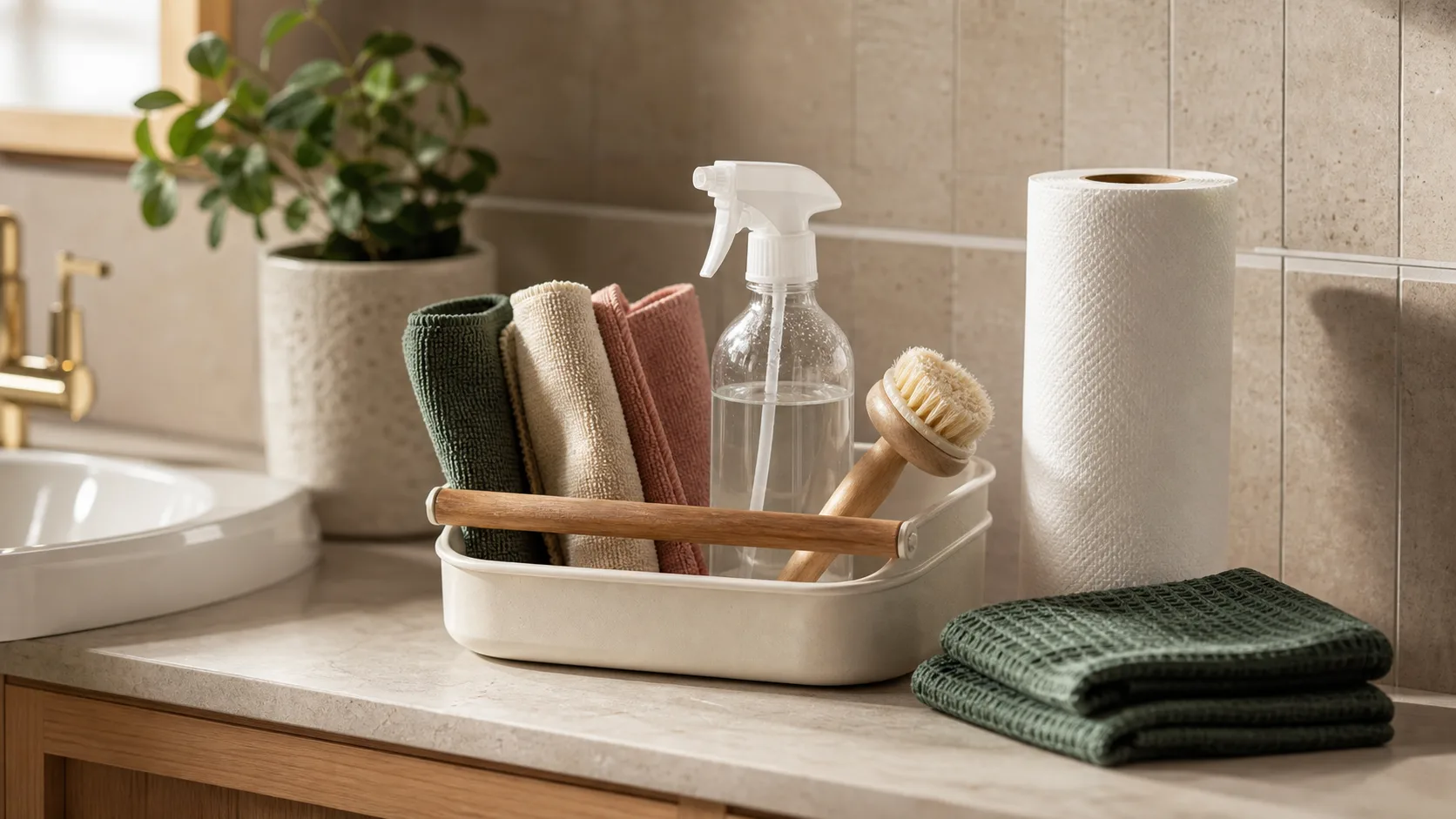
- Keep supplies where you use them, not in one far-off closet
- Use a small caddy you can carry room to room
- Keep a cloth and spray in the bathroom you clean most
- Put a trash bag where trash collects, not where it is tidy
Friction is the quiet killer of routines. Every extra step between you and the task is one more chance to skip it. When the spray is already on the bathroom shelf, wiping the sink is a ten-second decision instead of a five-minute project.
Pair cleaning with something you already do
Habits attach more easily when they ride along with an existing one.
This is sometimes called habit stacking, and it works because you are borrowing a trigger you already have.
A few examples:
- Wipe the counter while the kettle boils
- Clear the sink while dinner cools
- Squeegee the shower right after you get out
- Sort the mail the moment you walk in
- Start a load of laundry when you start the coffee
You are not adding a new slot to your day. You are tucking a small task into a moment that already exists. Over time it stops feeling like a separate decision at all.
Build in a forgiving reset
Every routine gets broken. You will travel, get sick, have a brutal week, or simply not feel like it. This is normal and it is not the end of the routine.
The routines that last are the ones with a plan for the bad week, not just the good one.
Give yourself a reset rule that is kind:
- Missing a day is not failure. Just do the next day.
- If everything falls apart, do one ten-minute reset to get unstuck, not a guilt-driven deep clean.
- Pick the single task that makes the biggest difference and start there.
Perfectionism quietly destroys routines. The moment a missed day feels like proof you "can't keep a routine," people quit. Treat a miss as a skipped rep, not a broken promise.
Adjust it after two weeks
Your first version will be wrong in small ways. That is expected.
After about two weeks, notice what actually happened:
- Which task did you skip every time? It may be on the wrong day, or it may be too big.
- Which task did you do without thinking? That anchor is working. Use the same kind of trigger elsewhere.
- Where did the house still feel behind? That spot may need more frequency.
- Where did you over-clean something that did not need it? Pull it back.
A routine is not something you design once and obey forever. It is something you tune. The version you keep for a year will look a little different from the one you started, and that is a sign it is working.
A simple starter routine
If you want a place to begin, try this for two weeks:
- Daily: wipe the main counter and clear the sink after the last meal
- One quick reset of your most-used room before bed
- Monday: bathrooms
- Wednesday: floors
- Friday: sheets and towels
- Weekend: one monthly task from a short rotation, then stop
That is the whole thing. It is meant to feel almost too easy, because easy is what survives a hard week.
What to try first
Tonight, pick one daily task and attach it to something you already do. Wipe the counter while the kettle boils, or clear the sink right after dinner.
Do only that for a few days. Do not add anything else yet.
Once that single habit feels automatic, add one weekly task on a day you will remember. Build the routine one small, sticky piece at a time, and let consistency do the work that intensity never could.